
CUET PG Economics is not won on exam day. It is won over the months before it, in the quiet work of turning economic reasoning into something automatic. On the day itself you do not have time to derive, reconstruct or second-guess. You need to read a question and know.
That is the real demand of this paper, and it is worth naming clearly, because it is different from what other entrance exams ask.
CUET PG Economics is not IIT JAM and it is not ISI MSQE
JAM and ISI MSQE test how far you can stretch a mathematical idea. They reward the student who can manipulate a hard function under pressure.
CUET PG rewards something else. It rewards comfort with fundamentals across a very wide syllabus. The difficulty of any single question sits at moderate to low. The challenge is coverage, recall and speed. A student who knows microeconomics to an advanced level but has never revised Indian Economy will lose more marks than a student who knows every topic at a working level.
Preparing for CUET PG as though it were JAM is one of the commonest mistakes aspirants make. The Shikhar Batch is built around the opposite assumption: cover everything, at the depth the paper actually asks for, and revise it often enough that it stays.
Course page: [CUET PG Economics 2027 Shikhar Batch](https://study.haqseeconomics.com/course/cuet-pg-economics-2027-shikhar-batch)
Full walkthrough of the portal on video: [Watch here](https://youtu.be/9rI5fscup_w)
One place instead of five tabs
Most aspirants lose time before they lose marks. The lecture is on one platform. The notes are a forwarded PDF. Practice questions are in a Telegram channel. Previous year papers are in a folder nobody has sorted. Revision is a notebook from six months ago.
Five sources, five tabs, and no way to tell whether a topic is actually finished.
On the HSE Portal, a topic is a single place. Open it and you get:
* The recorded live lecture, filed under that topic
* The full PDF of notes from that lecture, in the same place
* The assignment PDF for that topic
* Practice questions through the Quiz Simulator, filtered to that topic
* Flashcards for revision of that topic
* The reading pages that matter for that topic
Nothing to hunt for. You finish the topic and move on. Reducing this friction is not a cosmetic improvement. Over a year of preparation it is the difference between a syllabus that gets completed and one that does not.
Lectures pitched at the exam, not above it
Every lecture in the Shikhar Batch is designed by Ravit sir against the COQP-10 syllabus and against what CUET has actually asked from 2018 to 2026.
Each concept is built three ways: theoretically, graphically and numerically. A student should be able to state the idea, draw it and compute with it. That is the standard of understanding CUET questions are written to test, and going deeper than that costs time you need elsewhere.
The syllabus is large. The questions are fair. The course is calibrated to both.
Flashcards, and why ten minutes a day matters
CUET tests recall more than most people expect. Definitions, results, chronologies, committee names, policy dates. The flashcard deck on the portal exists for exactly this.
There are three modes, each for a different kind of session.
Classic: The familiar card and flip. After each card you mark your comfort as Again, Hard, Good or Easy, and the deck schedules itself around your answers.
Swipe: For fast revision. Right if you know it, left if you do not, then mark the card Easy or Hard and move on.
Speed Round: A timed run that scores every card you remember before the clock runs out. It trains the pace the actual exam demands. It also works well in pairs, with one student answering aloud and the other marking Know or Do Not Know. Revision stops being a solitary grind and starts being a game.
Settings you can control:
* Card pace and the Speed Round timer
* Study Ahead of Schedule, if you want any card at any time rather than waiting for the scheduled release
* Predicted intervals, if you want to see when a card will come back
* Sound effects and card animation, which can be switched off for students who prefer a quieter interface
Analytics show a thirty day streak, cards reviewed in total and by topic, and a retention percentage from your own sessions. The leaderboard ranks students by streak for Classic and Swipe, and by score for Speed Round.
Each card carries a short conceptual question with a full explanation on the back. Ten minutes a day, held over months, does more for retention than a week of panic in March.
Indian Economy: start early, in small pieces
Indian Economy is the most fact-heavy section of the CUET PG paper, and it is the section students most often leave for the end.
That is the worst way to handle it. A mind under time pressure retains facts poorly. Cramming a hundred schemes and figures in the final fortnight produces a week of confidence and a paper full of near misses.
Inside the Shikhar Batch, students are told plainly to begin this section early and to keep it moving in small daily increments. The flashcards were built with this section particularly in mind.
The question bank and the Quiz Simulator
The HSE CUET PG question bank runs into thousands of questions, written across every level and every testing trick the exam uses.
The Quiz Simulator lets you build your own paper:
* Single topic, or a mix of topics
* Filter by previous year questions only, or non-PYQ only
* Filter by questions you have already attempted, questions you have never seen, or a mix
* Choose how many questions you want in the sitting
There is also a mistake log. Every question you have answered incorrectly is stored, and you can practise from that set alone. For most students this is the highest-return twenty minutes available on the portal.
Doing the assignment after each topic keeps that topic fresh. Doing mixed-topic quizzes every week keeps the earlier topics from fading. Over a year-long preparation, that second habit is what protects the syllabus you covered in month two.
PYQ trends updated to 2026
Every topic in the course carries the previous year questions asked from it, tagged and updated through the 2026 paper. You can see, for any topic, how many times CUET has asked from it and in what form.
This changes how you allocate time. A topic with eleven questions across the years deserves more of your week than one with none. That judgement should not be guesswork, and on this portal it is not.
What the Shikhar Batch is, and what it is not
The Shikhar Batch is Ravit sir’s attempt at building a system that works alongside an aspirant for a full year: lectures, notes, assignments, flashcards, question bank, analytics and mentorship, in one academic environment, all of it held to a standard he is willing to put his name on.
What it is not is a substitute for your own work.
A course cannot study on your behalf. Every resource here is built to be used, and used regularly. Paid for and left idle, it will do nothing for your rank. Used properly, it gives you the material, the practice and the guidance to walk into the exam hall knowing you have seen this before.
That honesty matters to us more than a sales line. Join if you intend to use it.
Join the Shikhar Batch
Enrol here: [CUET PG Economics 2027 Shikhar Batch](https://study.haqseeconomics.com/course/cuet-pg-economics-2027-shikhar-batch)
See the portal before you decide: [Full feature walkthrough on YouTube] (https://youtu.be/9rI5fscup_w)
Questions:WhatsApp Haq Se Economics on 9971386686
Preparation Aur Selection, Haq Se!
Frequently asked questions
About the exam
What is the exam pattern for CUET PG Economics?
The paper code is COQP10. It carries 75 Economics questions to be answered in 90 minutes. Each correct answer is worth 4 marks and each wrong answer costs 1, for a total of 300 marks. Until 2023 the paper ran to 100 questions with a general section ahead of the domain questions. From 2024 onwards all 75 questions are from Economics.
What is the CUET PG Economics syllabus?
Microeconomics, Macroeconomics, Indian Economy, Statistics, Mathematics for Economics, Econometrics, International Economics and Public Economics. The Shikhar Batch covers all of it, topic by topic, at the level the paper tests.
How difficult is CUET PG Economics?
Question by question, moderate to low. The difficulty lies in the size of the syllabus and in the pace, not in the depth of any single question. A student who has covered everything at a working level will outscore one who has covered half of it in great depth.
How is CUET PG Economics different from IIT JAM and ISI MSQE?
JAM and ISI test mathematical depth on a narrower set of ideas. CUET PG tests working comfort across a much wider syllabus at moderate to low difficulty. Coverage, recall and speed matter more here than advanced technique.
Which section do students find hardest to score in?
Indian Economy, because it is the most fact-heavy part of the paper and the part most often left to the last few weeks. Started early and revised in small daily amounts, it becomes one of the most scoring sections instead.
How much time does CUET PG Economics preparation take?
A full year of steady work is the design assumption behind the Shikhar Batch. Three to four focused hours a day, held consistently, covers the syllabus with room left for revision and mock practice. Short bursts of long hours followed by gaps do not work for a syllabus this wide.
Can I prepare while I am in my final year of graduation?
Yes, and most students do. Lectures are available on the portal to watch when it suits you, and the flashcards are built for the days when ten minutes is all you have.
About the course
What is included in the Shikhar Batch for CUET PG Economics 2027?
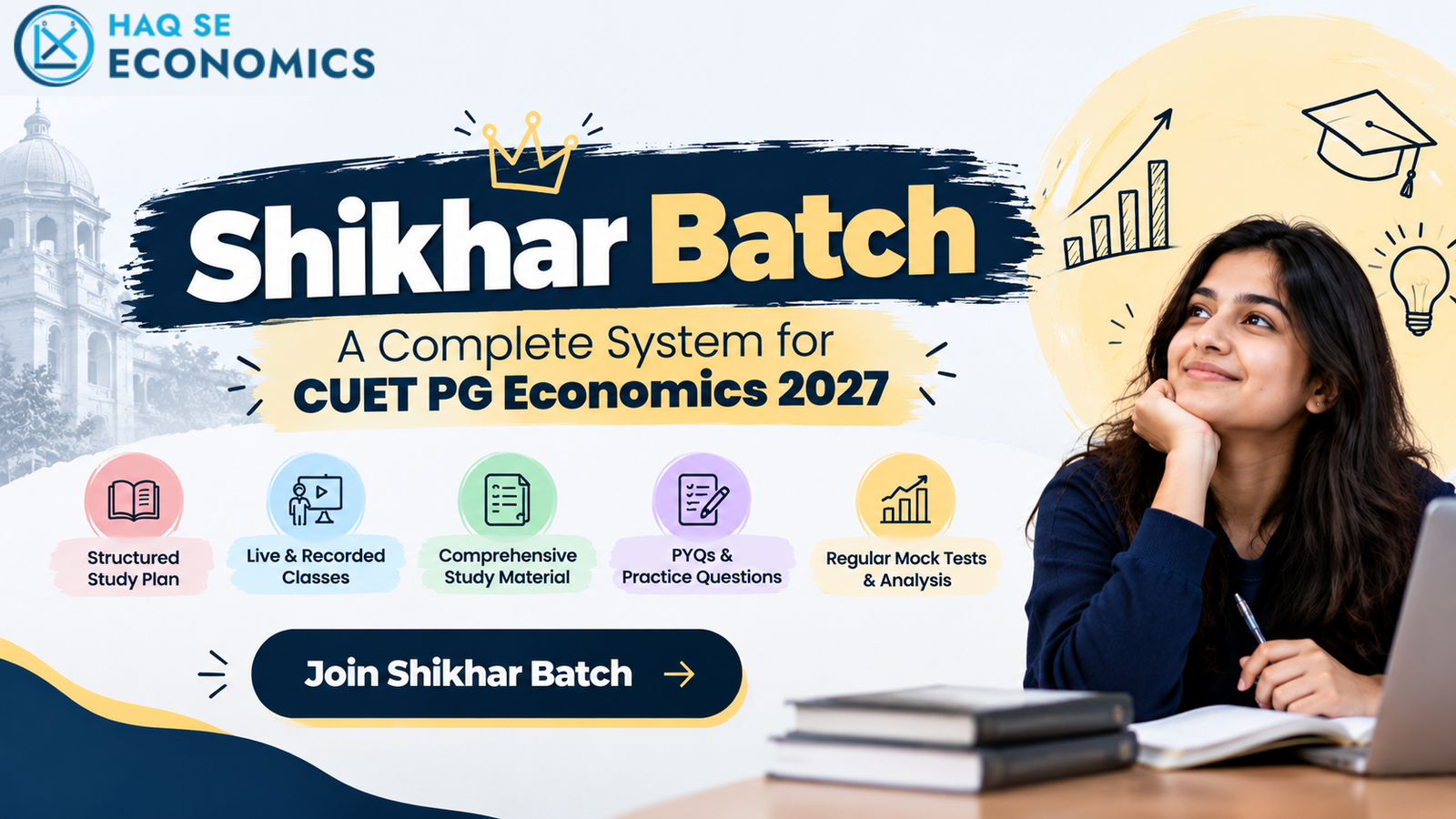
Topic-wise lectures across the full COQP-10 syllabus, lecture notes as PDFs, assignments after every topic, previous year questions tagged to each topic and updated through 2026, reading material, a question bank with a quiz simulator, and a flashcard deck with analytics. All of it sits inside the HSE Portal, organised topic by topic.
Is the course suitable for beginners?
Yes. Each concept is built from the base in three forms, theoretical, graphical and numerical, before any exam-level question is attempted. A student coming from a non-Economics background can follow the sequence from the first lecture.
Are the lectures live or recorded?
Lectures are taken live and then uploaded to the portal under the relevant topic, along with the notes PDF from that session. So you can attend live or watch later, and either way the recording stays with the topic.
Are previous year questions included?
Yes. Every topic carries the CUET PG questions asked from it, tagged and updated through the 2026 paper, so you can see how often a topic has appeared and in what form before deciding how much time it deserves.
Is reading material provided, or do I need to buy books?
Reading material is provided. Rather than sending you to a 900 page textbook, the course gives the specific pages worth reading for each topic, picked from the standard books and kept to what CUET actually asks.
Using the portal
How do the flashcards work?
Three modes. Classic is the standard card and flip, where you rate each card Again, Hard, Good or Easy and the deck schedules itself around your answers. Swipe is for fast revision, right if you know it and left if you do not. Speed Round is a timed run that scores the cards you remember before the clock runs out. Pace, timer, sound and card animation are all adjustable in Settings.
Can I practise only the questions I got wrong?
Yes. Every incorrect answer goes into your mistake log, and you can build a quiz from that set alone. For most students this is the highest-return practice available on the portal.
Can I set my own mock tests?
Yes. The Quiz Simulator lets you choose a single topic or a mix, set the number of questions, and filter by previous year questions, non-PYQ questions, questions you have already attempted or questions you have never seen.
How does the course track my progress?
Flashcard analytics show a thirty day streak, cards reviewed in total and by topic, and a retention percentage from your own sessions. A leaderboard ranks students by streak for Classic and Swipe, and by score for Speed Round. Quiz results and the mistake log track your accuracy topic by topic.
How much time should I give the portal each day?
Lecture and notes for the day’s topic, the assignment that follows it, and ten minutes of flashcards. Add one mixed-topic quiz a week to keep older topics from fading. That routine, held for a year, is what the batch is built around.
Joining
Where can I see the portal before joining?
The full feature walkthrough is on YouTube at https://youtu.be/9rI5fscup\_w
How do I enrol?
Through the course page at https://study.haqseeconomics.com/course/cuet-pg-economics-2027-shikhar-batch or by messaging Haq Se Economics on WhatsApp at 9971386686.