UGC NET Economics Preparation Strategy 2027 | Haq Se Economics

UGC NET Economics Exam Strategy
A Practical, Exam-Oriented Roadmap

Cracking UGC NET Economics (including JRF) is less about studying endlessly and more about studying in the right direction. Every year, capable students miss the cut-off not because they lack knowledge, but because their preparation is misaligned with the exam’s demand. This page gives you a clear, realistic, and time-tested strategy to prepare smartly for UGC NET Economics.

Why CUET PG Economics Preparation Strategy Matters?

A comprehensive grasp of the CUET PG Economics Syllabus is crucial for effective preparation.
Knowing the weightage of topics like Microeconomics, Macroeconomics, the Indian Economy,
and Statistics helps streamline your focus and maximize results

1. The Core Strategy: Direction Over Duration

UGC NET Economics rewards clarity, consistency, and precision, not random hard work.

Start Early

Do not wait for previous results or notifications. The earlier you begin, the more time you get for:

  • Concept-building
  • PYQ analysis
  • Multiple revisions

Early starters always have a structural advantage.

Smart Preparation Matters

Studying the wrong books, ignoring weightage, or skipping PYQ analysis can lead to failure even after long study hours.

Right direction > more hours.

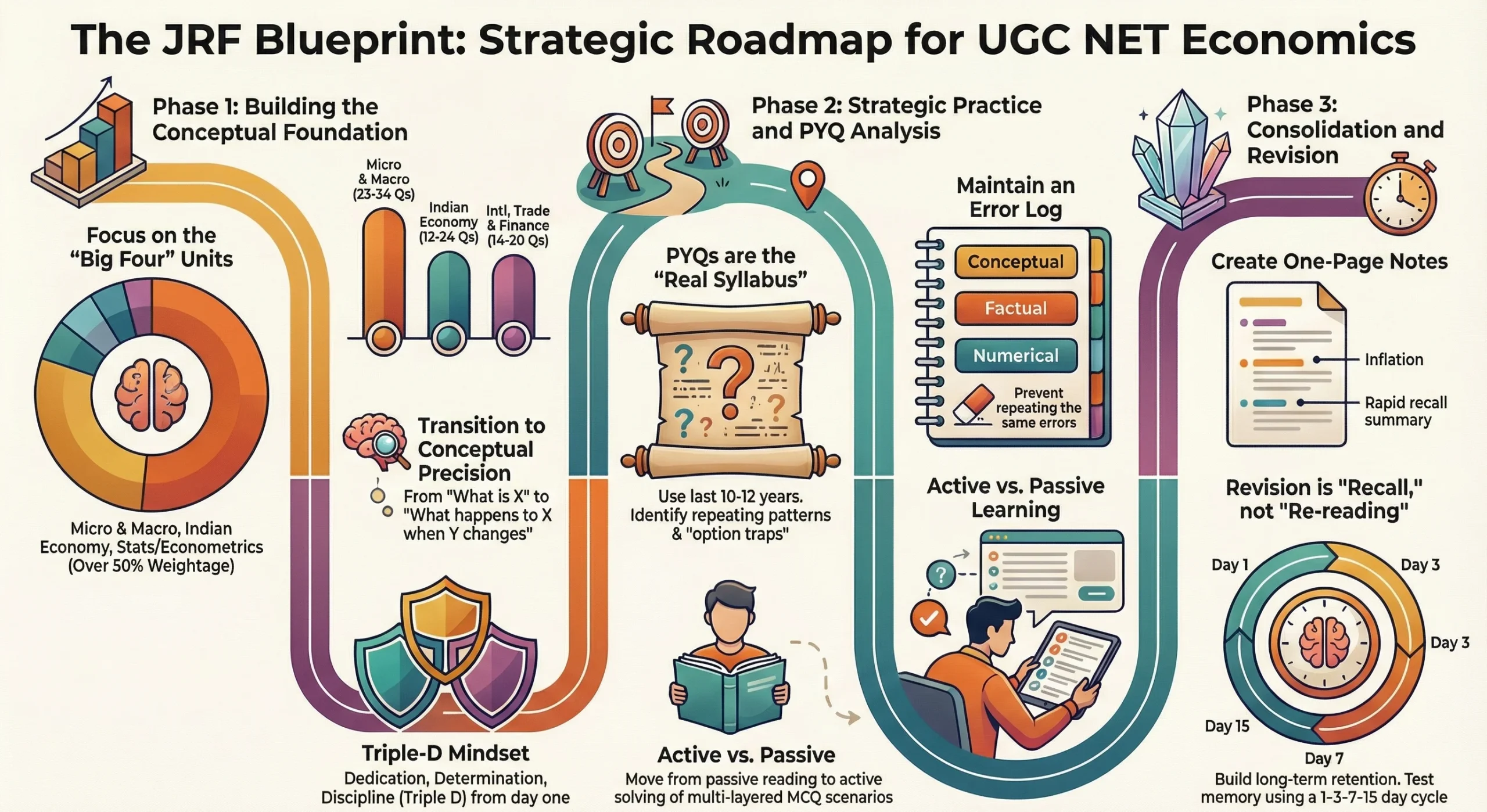
The “Triple D” Rule

Your preparation must rest on:

  • Dedication – daily effort
  • Determination – staying the course
  • Discipline – following a fixed plan

Consistency matters more than motivation. The energy you start with must sustain till exam day.

English Terminology Is Non-Negotiable

Even if you are a Hindi-medium student, learn economic terms in English.
This helps in:

  • Understanding advanced questions
  • Clearing interviews
  • Reading research papers and standard texts
Blueprint

2. Decoding the Syllabus the Right Way

The official syllabus gives you breadth, not depth. The real syllabus is hidden in PYQs.
PYQs Are the Real Syllabus

Analyze at least the last 10–12 years of PYQs (around 24 attempts). This reveals:

  • Repeating topics
  • Question patterns
  • Conceptual depth expected
Build Your Own Topic Map

Combine:

Create a detailed topic–subtopic list.
This exercise may take 15–20 days, but it eliminates guesswork for the rest of your preparation.

Understand the Shift in Question Style

UGC NET no longer asks:

“What is X?”

It now asks:

“What happens to X when Y changes under Z conditions?”

Conceptual application is key.

3. Study Plan & Resource Management

Limit Your Sources

One subject = one standard source.

Multiple books for the same unit create confusion, not clarity.

Ideal Preparation Timeline

A focused preparation usually needs 4–5 months, provided it is structured.
Suggested Daily Study Structure (6–8 hours)
Adjust hours as per your schedule, but keep daily balance.

4. High-Weightage Topics (Unit-Wise Focus)

Instead of treating all topics equally, use a heat-map approach.

Microeconomics

Macroeconomics

Statistics & Econometrics

Indian Economy

International Economics

Growth & Development

5. Note-Making & Revision Strategy

One-Page Notes

Every major topic should be compressed into one-page summaries:

Formula Sheets

Maintain a separate formula notebook:
Rewrite formulas weekly and understand their intuition, not just symbols.

Spaced Revision Cycle

Follow this revision pattern:
Revision means active recall, not passive reading.

Last 30 Days Rule

In the final month:

6. Mock Tests & Error Analysis

Accuracy First, Speed Later

Initially focus on getting questions right. Speed improves automatically with clarity.

Maintain an Error Log

After every mock, classify mistakes into:

Also analyse why the wrong options were wrong — this is where most learning happens.

Use Option Elimination

In the exam:

This significantly improves accuracy in conceptual MCQs.

Follow the Right Strategy. Achieve the Best Results.

Structured guidance, proven methods, and step-by-step strategies—everything is inside our complete

7. Standard Reference Books (Use Selectively)

Use books as reference tools, not cover-to-cover reading.

Final Takeaway

Most UGC NET JRF failures are strategy failures, not knowledge failures.

If your preparation is:

Your chances improve dramatically.

At Haq Se Economics, we design preparation exactly around these principles — so your effort translates into results, not frustration.

FAQs – UGC NET Economics Preparation Strategy

The best time to start is as early as possible, ideally 4–6 months before the exam. Early starters get enough time for concept-building, PYQ analysis, and multiple revisions, which are crucial for clearing JRF-level cut-offs.
UGC NET Economics is primarily a strategy-driven exam. Many students study for long hours but fail due to poor resource selection, lack of PYQ alignment, and inadequate revision. Smart planning always outperforms random hard work.
PYQs are central to UGC NET Economics preparation. They reveal topic weightage, conceptual depth, and the examiner’s thinking. Ignoring PYQs often leads to misdirected preparation.

No. All units are important, but not all units carry equal weightage. A heat-map approach—prioritising frequently asked topics—helps maximise score within limited preparation time.

Ideally, one standard book per subject. Using multiple sources for the same unit often leads to confusion, incomplete coverage, and revision problems.
Yes. Many successful candidates start with weak quantitative backgrounds. The key is conceptual clarity, repeated practice, and formula-based revision, rather than avoiding these units altogether.
There is no fixed number. What matters more is post-test analysis. Every mock should be followed by detailed error analysis to identify conceptual, factual, and silly mistakes.

The final month should be dedicated to:

  • Revision and consolidation
  • Formula recall
  • PYQ-based practice
  • Mock test analysis

Avoid starting completely new topics during this phase.

Accuracy comes first. Since there is no negative marking, students often rush and make avoidable errors. A strong conceptual base naturally improves speed over time.
Not if you consciously learn economic terminology in English alongside concepts. This helps in understanding questions better and is essential for interviews and academic progression.
Self-study can work only if your strategy, resources, and revision plan are correct. Many students struggle because they don’t know what to study, how much to study, and what to ignore.

If you want a structured, exam-aligned preparation with:
Concept-focused video lectures
Topic-wise and full-length tests
PYQ-based strategy and analysis
you can explore our UGC NET Economics courses and test series at Haq Se Economics.
These courses are designed specifically to convert effort into results.

Use the Strategy That Toppers Follow

Step-by-step exam plan and proven methods — all included in our premium course.

Get in Touch !

Have any query? We’d love to answer them. Fill out the form below.