
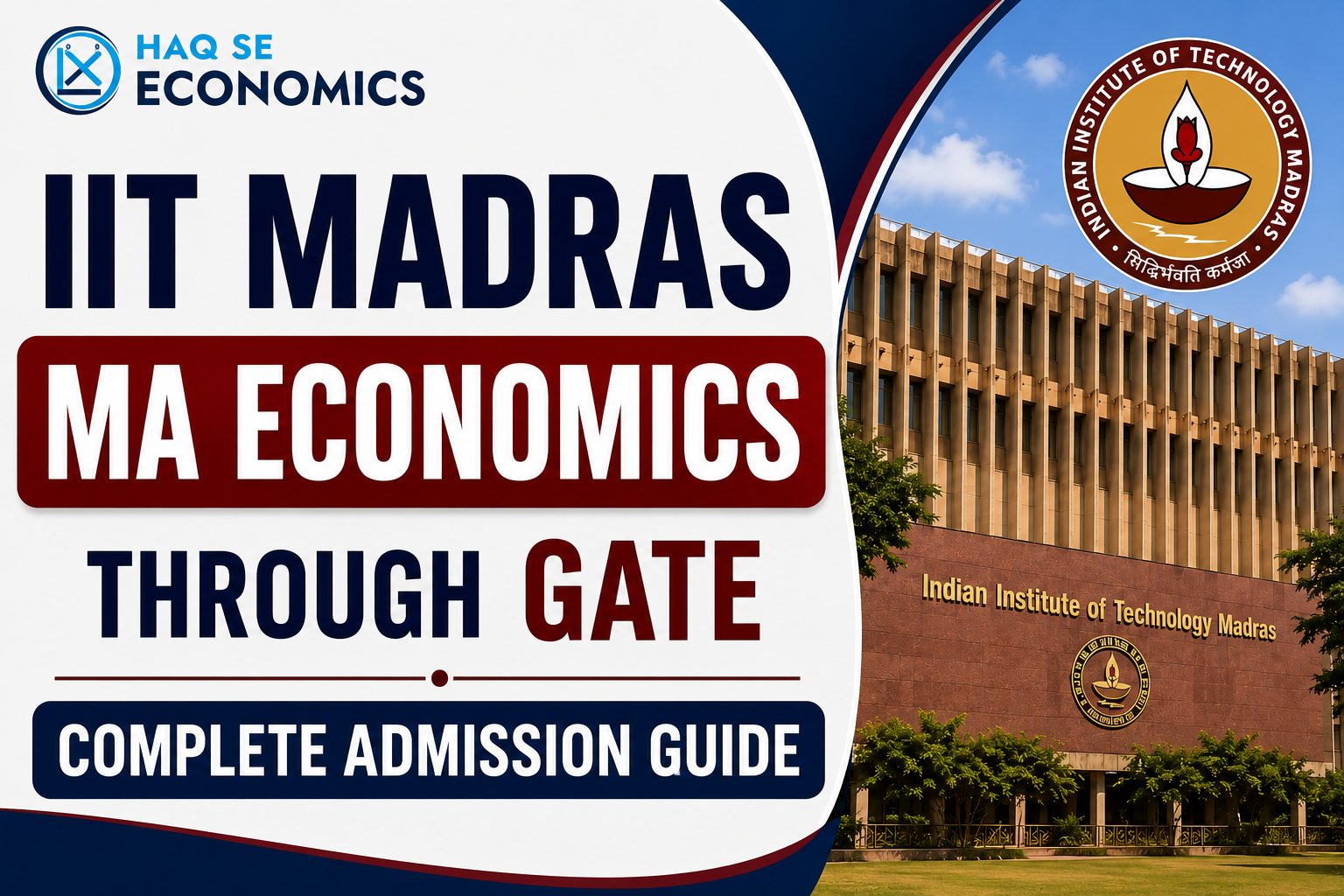
Why IIT Madras MA Economics?
Let’s be honest – when most Economics students think of postgraduate options, they think of DSE or JNU. IIT Madras doesn’t come up as often. That’s a mistake.
IIT Madras offers one of the most rigorous and quantitatively strong MA Economics programs in India – backed by the IIT brand, world-class faculty, and a placement record that speaks for itself. And the entry route is GATE Economics, not IIT JAM.
If you’re serious about economics, research, or a high-paying private sector career, this program deserves your full attention.
Eligibility Criteria
Before you start preparing, make sure you qualify. Here’s what IIT Madras requires:
Educational Qualification
- Bachelor’s degree of 3 years (B.A. or equivalent) under the 10+2+3 pattern from any recognized university
- Students in 3rd year or higher of any undergraduate degree can also appear for GATE
- IIT B.Tech graduates with CGPA 8.0 and above can apply without a GATE score
GATE Paper
- You must qualify the XH (Humanities and Social Sciences) GATE paper with Economics as the subject
- Valid GATE scores: GATE 2024, GATE 2025, or GATE 2027 are all accepted
- No age limit for GATE – you can appear any number of times
GATE Economics Syllabus – What You Need to Prepare
The GATE Economics (XH-C1) paper is based on undergraduate-level Economics. Here’s what’s covered:
Microeconomics
- Consumer theory – utility maximization, demand functions, Slutsky equation
- Production & costs – production functions, cost minimization
- Market structures – perfect competition, monopoly, oligopoly, game theory
- General equilibrium and welfare economics
Macroeconomics
- National income accounting
- IS-LM framework and money markets
- Inflation, unemployment, and business cycles
- Economic growth models – Solow, Harrod-Domar
- Open economy macroeconomics and balance of payments
International Economics
- Trade theories – Ricardian, Heckscher-Ohlin
- Exchange rate systems and international monetary system
Public Finance
- Public goods, externalities, and market failure
- Taxation principles and fiscal policy
Mathematics & Statistics
- Calculus, linear algebra, and optimization
- Probability theory, statistical inference, regression analysis
What the MA Economics Program Looks Like
This isn’t your typical MA where you sit through lectures and write exams. IIT Madras’s MA Economics is built for people who want to actually understand and apply Economics.
Core Courses (11 mandatory)
- Microeconomics I & II
- Macroeconomics I & II
- Econometrics I & II
- Mathematical Economics
- Development Economics
- Public Economics
- Indian Economy
Electives
- Healthcare Economics
- Financial Economics
- Climate & Environmental Economics
- Plus interdisciplinary electives from other IIT Madras departments
Research Project
The program culminates in a mandatory MA research project – this is where you apply everything you’ve learned. It’s also your portfolio piece for PhD applications or jobs.
- Minimum 200 credits required for degree completion
- Option to upgrade to PhD as per IIT Madras guidelines
Step-by-Step Admission Process
Here’s exactly how you get in – no confusion:
- Step 1: Appear for GATE 2027 in the XH (Economics) paper
- Step 2: After results, register on the IIT Madras admissions portal at mtechadm.iitm.ac.in
- Step 3: Also register on the COAP portal (Common Offer Acceptance Portal) – mandatory
- Step 4: Fill application form, upload GATE scorecard, academic documents, category certificate
- Step 5: Seat allotment based on GATE score and choices given in the application
- Step 6: First set of offers typically released in the 2nd week of May
- Step 7: Accept offer, pay fees, submit medical fitness certificate, and report on joining date
Important: You must register on BOTH the IIT Madras portal and COAP. Missing either means your application won’t be processed.
GATE Cutoff for IIT Madras MA Economics
The overall GATE cutoff range for MA Economics at IIT Madras has been 226 to 737 across all categories. Cutoffs vary by category:
- General category – higher cutoff, more competition
- OBC-NCL – lower than General
- SC/ST/PwD – significantly lower, use your reservation advantage
Since only 25 seats are available, competition is real. A strong GATE score – ideally in the top range – gives you a comfortable shot.
Track live cutoffs: IIT Madras Official Admissions Portal
Career Outcomes – Where Graduates Go
This is where IIT Madras really stands apart from other MA Economics programs in India.
Private Sector (Strong IIT Placement Network)
- Consulting: McKinsey, BCG, PwC, Deloitte
- Banking & Finance: Goldman Sachs, JP Morgan Chase, Deutsche Bank, Merrill Lynch, Wells Fargo
- Analytics & Tech: American Express, EXL Service, Mastercard, Walmart, Wipro
- Other: Edelweiss, ICICI Bank
Research & Academia
- PhD programs at top Indian and international universities
- Research positions at think tanks and policy institutes
Government & Policy
- RBI, NITI Aayog, Ministry of Finance, economic advisory roles
IIT Madras MA vs Other Options – Quick Comparison
IIT Madras MA vs DSE MA Economics
- DSE – stronger Economics legacy and alumni network in academia
- IIT Madras – stronger quantitative training, better private sector placements, IIT brand
IIT Madras MA vs IIT JAM (M.Sc. Economics at other IITs)
- Entry via GATE (XH paper) for IIT Madras MA – different from IIT JAM
- Both are excellent – IIT Madras MA is more research and analytics focused
Also read: IIT JAM Economics – Complete Guide
Prepare for GATE Economics with Haq Se Economics
Cracking GATE Economics requires the same depth of preparation as IIT JAM Economics – strong concepts in Micro, Macro, Statistics, and Maths. Shortcuts don’t work here.
Haq Se Economics, founded by Ravit Thukral (ex-Delhi School of Economics, former St. Stephen’s College lecturer), is one of India’s most trusted platforms for Economics entrance exam preparation – covering both GATE Economics and IIT JAM Economics.
- Concept-first teaching – not formula memorization
- Full syllabus coverage for GATE XH Economics
- Previous year question analysis
- Test series and mock papers
- Active community of serious aspirants
Conclusion
IIT Madras MA Economics is one of the most underrated postgraduate programs in India for Economics students. Twenty-five seats, IIT-level rigor, incredible placements, and fees that are almost embarrassingly low for what you get.
The entry route is GATE Economics – one exam, one chance to change your trajectory. Prepare seriously, prepare smart, and this program is absolutely within reach