
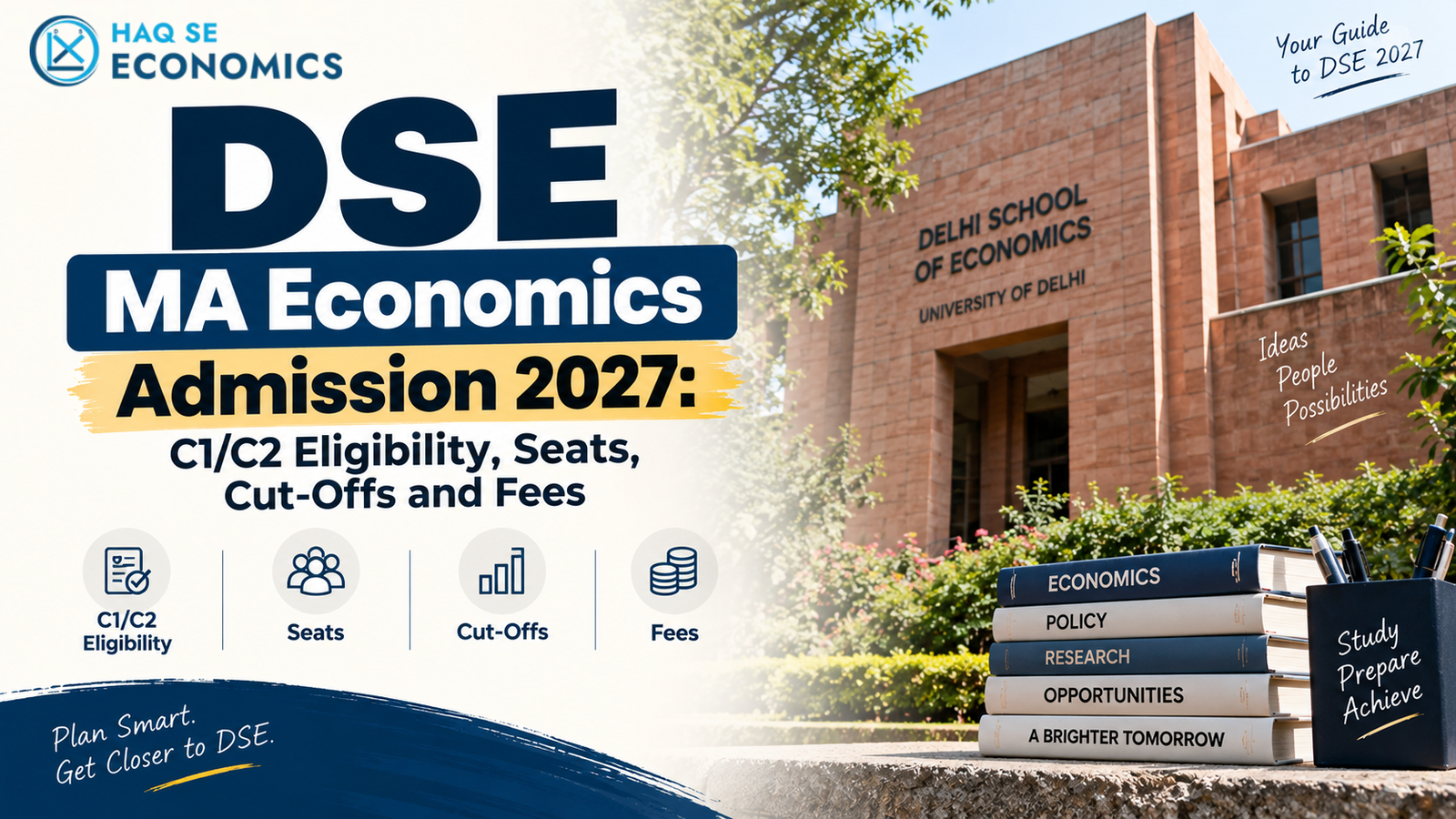
The Delhi School of Economics, commonly called DSE or D-School, is one of India’s most respected destinations for postgraduate Economics. Admission to its two-year MA Economics programme is based on the CUET PG Economics paper, COQP10, followed by registration and seat allocation through the University of Delhi’s Common Seat Allocation System for postgraduate programmes, or CSAS (PG).
For the 2026-27 admission cycle, the Department of Economics offered 290 regular seats across two eligibility categories. The first-round minimum allocation score for an Unreserved C1 candidate was 253 out of 300, while the corresponding C2 score was 244. These numbers demonstrate how competitive DSE admission can become when the CUET PG Economics paper is relatively easy.
This guide explains the eligibility rules, C1 and C2 categories, seat matrix, reservation system, recent cut-offs, admission process and expected costs in one place.
2027 update note: At the time of publication, the University of Delhi’s definitive 2027-28 postgraduate bulletin and allocation scores may not yet be available. The verified figures below come from official 2026-27 DU documents and should be used as a planning reference, not as a guarantee. Candidates must check the latest DU and NTA notices before applying.
DSE admission at a glance
| Question | Quick answer |
| Entrance paper | CUET PG Economics (COQP10) |
| Interview | No interview for the regular two-year MA Economics route |
| Admission portal | DU CSAS (PG), after appearing for CUET PG |
| Regular seats in 2026-27 | 290: 145 under C1 and 145 under C2 |
| C1 eligibility in 2026-27 | Recognised bachelor’s degree plus Class XII Mathematics or at least four bachelor’s-level Mathematics credits |
| C2 eligibility in 2026-27 | Specified DU Economics Honours, Major or Minor degree routes |
| 2026 Round 1 C1 UR score | 253 out of 300 |
| 2026 Round 1 C2 UR score | 244 out of 300 |
| Best place to verify updates | DU Admission website and the official NTA CUET PG portal |
Find the information you need
· Checking eligibility? See the C1 and C2 eligibility rules.
· Confused about C1 and C2? Use the C1 versus C2 comparison.
· Looking for seats or reservation details? See the complete regular seat matrix.
· Looking for recent cut-offs? See the official 2026 allocation scores.
· Planning your budget? See fees and expected costs.
· Ready to apply? Use the admission checklist.
· Ready to prepare? Read the preparation guide and explore the CUET PG Economics 2027 Shikhar Batch.
What is the Delhi School of Economics?
The Delhi School of Economics was established in 1949 as a centre for advanced teaching and research in the social sciences. Today, it comprises the Departments of Economics, Geography and Sociology. The MA Economics programme discussed in this guide is offered by the Department of Economics at the University of Delhi’s North Campus.
DSE’s reputation rests on its rigorous quantitative training, influential faculty and alumni, research culture and strong pathways into industry, public policy and doctoral study. Its location inside a major public university also makes it more affordable than many private postgraduate programmes.
Students should distinguish between the Delhi School of Economics as a school and the Department of Economics as the department offering the MA Economics programme. On DU allocation documents, the programme is normally listed as “Master of Arts (Economics)” under the “Department of Economics”.
How does DSE MA Economics admission work?
For the two-year MA Economics programme, the 2026-27 DU bulletin required applicants to:
1. satisfy the programme-specific eligibility criteria;
2. appear for CUET PG Economics, paper code COQP10;
3. register separately on the University of Delhi’s CSAS (PG) portal;
4. fill programme and department preferences correctly;
5. participate in the applicable allocation rounds; and
6. complete document verification and fee payment within the notified deadline after allocation.
There is no interview for the regular MA Economics admission route. Merit for the two-year programme is based on the relevant CUET PG score, subject to eligibility, category, seat availability, tie-breaking rules and document verification.
Appearing for CUET PG alone is not enough. A candidate who does not register on DU’s CSAS (PG) portal, fails to select the correct preferences or misses an acceptance or payment deadline can lose the opportunity to secure a seat.
DSE MA Economics eligibility: Category 1 and Category 2
The University of Delhi divides eligible applicants into C1 and C2 for MA Economics. These are admission eligibility pools, not social-reservation categories.
Category 1 (C1): the open eligibility route
Under the official 2026-27 bulletin, C1 required:
· a three-year or four-year bachelor’s degree from a recognised university; and
· Mathematics in Class XII or at least four credits in Mathematics in the bachelor’s degree.
C1 is the route available to eligible graduates from outside the University of Delhi as well as eligible DU graduates. A degree in Economics is not compulsory under this route, but the Mathematics condition is.
This is an important correction to older or informal admission summaries. The 2026-27 regular postgraduate bulletin did not state a 50% general or 45% reserved-category aggregate threshold in the C1 row for MA Economics. Applicants must always follow the eligibility wording in the bulletin for their own admission year.
Category 2 (C2): the DU Economics route
Under the 2026-27 bulletin, C2 included candidates with either:
· a three-year or four-year Bachelor’s (Honours) degree in Economics from the University of Delhi; or
· a four-year bachelor’s degree with a Major or Minor in Economics from the University of Delhi.
Candidates who meet C2 eligibility are considered within the C2 allocation pool. The bulletin also states that all candidates are considered in the common merit process, while only eligible University of Delhi students are considered for C2.
C1 versus C2 at a glance
| Feature | Category 1 (C1) | Category 2 (C2) |
| Who can apply? | Eligible graduates from any recognised university, including DU | Eligible DU Economics graduates specified in the bulletin |
| Economics degree compulsory? | No | Yes, in the form prescribed for C2 |
| Mathematics condition | Class XII Mathematics or at least four bachelor’s-level Mathematics credits | Eligibility arises from the specified DU Economics degree route |
| CUET paper | COQP10 | COQP10 |
| Separate interview | No | No |
| Seat pool in 2026-27 | 145 regular seats | 145 regular seats |
Which category applies to you? If you have the DU Economics degree specified under C2, check whether the CSAS system considers you for C2 as well as the common merit process. If you graduated from another university—or from DU in a different discipline—check the C1 bachelor’s-degree and Mathematics conditions. When in doubt, obtain clarification from DU before registration closes.
Degree-wise C1 or C2 category finder
Use the table below for the degree combinations that create the most confusion. It applies to the official DU rules for the 2026-27 two-year MA Economics admission cycle.
| Candidate’s degree | DSE category | Why |
| Three-year DU BA (Hons.) Economics | C2 | The C2 rule expressly includes a three-year/four-year DU Bachelor’s (Honours) degree in Economics |
| Four-year DU BA (Hons.) Economics | C2 | Expressly included under the DU Economics Honours route |
| Three-year DU BA Programme with Economics as a discipline, subject or stated major | C1 | The non-Honours Major/Minor route is expressly limited to a four-year DU bachelor’s degree |
| Four-year DU BA Programme with an officially recorded Major in Economics | C2 | The C2 rule includes a four-year DU bachelor’s degree with a Major in Economics |
| Four-year DU BA Programme with an officially recorded Minor in Economics | C2 | The C2 rule also includes a four-year DU bachelor’s degree with a Minor in Economics |
| Four-year DU BA Programme with some Economics papers but no formal Economics Major or Minor | C1 | Merely studying Economics papers is not the same as holding the Major/Minor specified for C2 |
| DU BA (Hons.) Business Economics, BBE or a Business Economics degree | C1 | The MA Economics C2 rule names Economics, not Business Economics |
| BA (Hons.) Economics from a university other than DU | C1 | C2 is restricted to the specified University of Delhi degree routes |
| Economics Major or Minor from a university other than DU | C1 | The four-year Major/Minor route under C2 specifically requires a DU degree |
| Bachelor’s degree in another subject from DU or another recognised university | C1 | An Economics degree is not compulsory for C1 |
Remember: Every C1 candidate must also satisfy the C1 Mathematics condition: Mathematics in Class XII or at least four credits in Mathematics during the bachelor’s degree. The degree label alone is not enough.
Business Economics students: an important clarification
BA (Hons.) Business Economics, BBE and similar Business Economics degrees are not expressly listed under C2 for DSE MA Economics in the 2026-27 bulletin. DU uses “Economics” and “Business Economics” as distinct degree descriptions elsewhere in the same bulletin. A Business Economics graduate should therefore plan under C1, provided the recognised-degree and Mathematics conditions are satisfied.
Do not select C2 merely because the degree contains the word “Economics”. If DU changes or clarifies this treatment for 2027-28, follow the new bulletin and CSAS instructions.
The Mathematics requirement explained
For C1, a candidate must satisfy at least one of the two Mathematics pathways listed in the 2026-27 bulletin:
· Mathematics in Class XII; or
· at least four credits in Mathematics during the bachelor’s degree.
The wording “at least four credits” matters. A course that appears quantitative but is not recorded as Mathematics may not automatically qualify. If your transcript uses a different credit system, or your course title is ambiguous, seek written clarification from the University of Delhi Admission Branch before relying on it.
Do not confuse admission eligibility with academic readiness. Meeting the minimum Mathematics condition does not mean that the MA curriculum will be easy. DSE Economics is quantitatively demanding, and incoming students benefit from revising calculus, optimisation, matrix algebra, probability and statistics before classes begin.
DSE MA Economics seat matrix
The official 2026-27 DU postgraduate bulletin listed 290 regular seats in the Department of Economics: 145 in C1 and 145 in C2.
| Social category | C1 seats | C2 seats | Total regular seats |
| Unreserved (UR) | 59 | 59 | 118 |
| Scheduled Caste (SC) | 21 | 22 | 43 |
| Scheduled Tribe (ST) | 11 | 11 | 22 |
| OBC-NCL | 39 | 39 | 78 |
| Economically Weaker Sections (EWS) | 15 | 14 | 29 |
| Total | 145 | 145 | 290 |
Supernumerary seats, including applicable PwBD, CW, foreign-national and other University categories, operate according to DU rules and are not simply added to the regular seat matrix above. The bulletin warns that the seat matrix may vary, so candidates should verify the latest version for their cycle.
How reservation and the Unreserved category actually work
“Unreserved” does not mean “reserved for General-category candidates”. It is an open merit category. A candidate belonging to SC, ST, OBC-NCL or EWS who meets the Unreserved allocation threshold on their own merit can be allocated against an Unreserved seat, subject to the applicable DU rules.
Reserved seats provide category-based access when an eligible candidate is considered within the relevant reservation category. Holding a category certificate does not prevent a high-scoring candidate from competing in open merit.
For example, an SC candidate who satisfies the eligibility conditions and reaches the C1 Unreserved allocation level may be allocated in C1 UR rather than using an SC seat. This is why students should not think of the 59 C1 UR seats as seats that only applicants without any reservation certificate can obtain.
Candidates claiming OBC-NCL, EWS, SC, ST, PwBD, CW or another benefit must upload valid documents in the prescribed format and period. Certificate wording, issuing authority and validity dates matter. A category claim can fail at verification even when the candidate’s CUET score is high.
DSE MA Economics cut-off 2026: official minimum allocation scores
DU uses the term minimum allocation score, which is more precise than “cut-off”. It is the lowest score associated with an allocation in a particular programme, department, category and round. It can change because of withdrawals, cancellations, reconciliations, grievances, upgrades and seat availability.
First-round minimum allocation scores for 2026-27
| Admission category | C1 score | C2 score |
| UR | 253 | 244 |
| EWS | 237 | 230 |
| OBC-NCL | 235 | 217 |
| SC | 221 | 200 |
| ST | 192 | 145 |
| PwBD | 153 | Not shown in the first-round Economics rows retrieved |
The official first-round document also listed a C1 Kashmiri Migrant allocation score of 172. Candidates in supernumerary or special categories should read the relevant DU documents rather than extrapolating from the regular table.
What happened in Round 2?
For 2026-27, the C1 UR minimum allocation score remained 253 in Round 2. The C2 UR score moved from 244 to 243. Several category scores also changed slightly, while some remained unchanged. This is a useful reminder that later-round movement is not uniform across categories.
How 2026 compared with 2025
The official 2025-26 first-round minimum allocation score for C1 UR in MA Economics was 189, compared with 253 in 2026-27. The C2 UR score was 169 in 2025’s first round.
That large year-to-year difference should change how aspirants interpret past cut-offs. A raw score is not equally difficult to obtain in every paper. When a paper is more direct, factual or widely attemptable, scores can cluster near the top. When it is more mathematical, statistical or time-intensive, the allocation threshold may be much lower.
What is a safe score for DSE MA Economics?
There is no permanently safe score because paper difficulty and the score distribution change. Preparing only to beat last year’s number is a fragile strategy.
A better target is to build the accuracy and coverage needed to remain competitive under different paper types:
· for an easier, fact-heavy paper, minimise careless errors because one or two questions can affect rank sharply;
· for a quantitative paper, improve calculation speed and question selection;
· for a mixed paper, maintain balanced preparation across theory, Mathematics, Statistics and Indian Economy; and
· in every case, use full-length mocks to develop a repeatable attempt strategy.
Treat previous allocation scores as historical evidence, not a prediction of your admission result.
Preparing for a high DSE score? Haq Se Economics’ CUET PG Economics 2027 Shikhar Batch is the flagship preparation course for COQP10. Review the course page, batch structure and current access details to decide whether it fits your starting level.
Why DSE cut-offs fluctuate so much
The contrast between 2025 and 2026 illustrates three forces:
1. Paper difficulty
A more accessible paper allows a larger group of candidates to score highly. This pushes competitive allocation scores upward.
2. Topic composition
A paper dominated by facts and familiar theory rewards a different preparation profile from one with heavier Mathematics and Statistics. Aspirants who prepare narrowly can benefit in one year and struggle in another.
3. Seat and preference dynamics
Minimum allocation scores reflect not only the exam but also programme preferences, eligibility pools, category, seat availability, upgrades, withdrawals and tie-breaking rules.
This is why serious DSE preparation must cover the complete COQP10 syllabus rather than trying to forecast which unit NTA will favour.
DSE MA Economics fees and cost of study
DSE remains comparatively affordable, but students should verify the current department fee notice before paying or budgeting. The source research compiled for this article reports an annual tuition-related amount of approximately ₹13,845, annual library charges of approximately ₹2,000 and a summer-internship registration charge of approximately ₹2,000. Hostel costs were estimated at roughly ₹40,000-₹45,000 annually, subject to hostel, mess and other charges.
These amounts can change and are not reproduced as an official 2027 fee quotation. The 2026-27 DU bulletin specifically directs candidates to the relevant department website for the updated fee structure.
Your full budget should include:
· University and department fees;
· examination or registration charges, where applicable;
· books, printing and software;
· hostel or rented accommodation;
· mess and daily living expenses;
· travel; and
· a laptop and reliable internet access for quantitative assignments and research work.
Hostel accommodation is limited and should never be assumed merely because admission has been secured.
DSE admission application checklist
Use this sequence to avoid administrative mistakes:
Before CUET PG registration
· Read the latest NTA CUET PG Information Bulletin.
· Confirm that COQP10 is the required paper for DU MA Economics.
· Check whether you meet C1, C2 or both eligibility routes.
· Verify the Mathematics requirement against your Class XII marksheet or university transcript.
· Arrange valid social-category or supernumerary certificates, if applicable.
During the CUET PG phase
· Register with consistent personal details.
· Prepare the complete official COQP10 syllabus.
· Download and preserve the confirmation page, admit card and scorecard.
During DU CSAS (PG)
· Register separately on the DU portal.
· Enter details exactly as they appear in your official documents.
· Select MA Economics and the Department of Economics carefully.
· Complete preference filling before the deadline.
· Monitor every allocation round and official notice.
· Accept, upgrade or freeze only after understanding the portal rules.
· Pay the admission fee before the stated deadline.
Common mistakes that can cost a DSE seat
Assuming CUET registration automatically registers you with DU
It does not. CUET PG and DU CSAS (PG) are separate stages.
Using an old eligibility rule
Admission conditions can change. A blog, coaching video or previous bulletin is not the final authority for your cycle.
Misunderstanding C1 and C2
C1 and C2 are eligibility pools. They are not synonyms for “outsider” and “General category”, nor are they social reservation categories.
Uploading an invalid category certificate
Certificates must satisfy DU’s format, authority and validity requirements. Do not wait until allocation week to check them.
Treating a previous cut-off as a target score
The C1 UR first-round score moved from 189 in 2025 to 253 in 2026. A fixed target based on one paper can be dangerously misleading.
Ignoring Mathematics after checking eligibility
Mathematics is not just an entry condition. It is central to succeeding in the MA Economics curriculum.
Why students aim for DSE MA Economics
DSE combines a long academic history with rigorous postgraduate training. Its MA curriculum develops foundations in Microeconomics, Macroeconomics, Mathematical Economics, Statistics and Econometrics while offering room to explore fields such as public economics, development, finance, health, education, labour, game theory, trade, time series and political economy.
The programme is demanding. Clearing CUET PG shows that a student has performed well in the entrance process; it does not by itself guarantee readiness for graduate-level proofs, optimisation, econometric reasoning or sustained academic workload.
That challenge is part of DSE’s value. Students learn in a strong peer group and can build profiles for research, policy, consulting, analytics, finance, government examinations and PhD applications.
Preparing for DSE with Haq Se Economics
Haq Se Economics was founded by Ravit Thukral, a Delhi School of Economics alumnus and former Lecturer at St. Stephen’s College, University of Delhi.
Its flagship course for this examination is the CUET PG Economics 2027 Shikhar Batch. It is designed for aspirants targeting DSE and other universities that use CUET PG Economics.
Why the course is relevant to a DSE aspirant
· preparation is organised around the COQP10 syllabus;
· teaching covers conceptual, quantitative and fact-based areas;
· PYQ practice helps students recognise recurring ideas and option traps;
· mock tests and performance analysis support exam strategy;
· the HSE Quiz Simulator enables targeted practice and revision; and
· live teaching is complemented by recorded support.
Because DSE cut-offs can swing sharply with paper difficulty, the preparation approach covers both conceptual-quantitative material and factual areas such as Indian Economy. The aim is not to predict the next paper, but to reduce dependence on any one paper type.
Students should review the current batch schedule, validity, inclusions and access details on the course page before enrolling.
View the CUET PG Economics 2027 Shikhar Batch
Frequently asked questions
Is DSE admission based only on CUET PG?
For the regular two-year MA Economics route described in the 2026-27 DU bulletin, allocation merit is based on CUET PG COQP10, subject to programme eligibility, category, seat availability, tie-breaking rules, document verification and completion of DU CSAS (PG). There is no interview.
Can a non-Economics graduate apply for DSE MA Economics?
Yes, under the 2026-27 C1 rule, a candidate could hold a recognised three-year or four-year bachelor’s degree in another field, provided they also had Mathematics in Class XII or at least four credits in Mathematics in the bachelor’s degree.
Is Mathematics compulsory for DSE MA Economics admission?
For C1 applicants in 2026-27, yes: the candidate needed Mathematics in Class XII or at least four Mathematics credits during the bachelor’s degree. C2 had a separate DU Economics degree-based eligibility route.
What is the difference between C1 and C2 in DSE admission?
C1 is the broader eligibility route for recognised bachelor’s-degree holders who meet the Mathematics condition. C2 is reserved for the DU Economics degree profiles specified in the bulletin. Both use COQP10 scores but have separate seat pools and allocation scores.
Is a three-year DU BA Programme student with Economics eligible under C2?
No, not under the wording of the 2026-27 bulletin. The three-year C2 route requires a DU Bachelor’s (Honours) degree in Economics. A three-year BA Programme student should apply under C1 and must satisfy the C1 Mathematics condition.
Is a four-year DU BA Programme student with an Economics Major eligible under C2?
Yes, if the four-year University of Delhi degree or official academic record identifies Economics as the candidate’s Major. The 2026-27 C2 rule expressly includes a four-year DU bachelor’s degree with a Major in Economics.
Is a four-year DU BA Programme student with an Economics Minor eligible under C2?
Yes. The same C2 rule includes a four-year DU bachelor’s degree with either a Major or Minor in Economics. The Minor should be formally recorded; merely completing a few Economics electives may not be sufficient.
Is BA (Hons.) Business Economics or BBE included in C2?
No, not under the published 2026-27 MA Economics eligibility wording. C2 names a DU Bachelor’s (Honours) degree in Economics or a four-year DU degree with an Economics Major/Minor. Business Economics is not named and should be treated as C1, subject to the C1 Mathematics requirement.
Is a non-DU BA (Hons.) Economics graduate eligible under C2?
No. C2 is restricted to the specified University of Delhi degree routes. A BA (Hons.) Economics graduate from another recognised university falls under C1 and must satisfy its Mathematics condition.
What if my DU transcript shows Economics papers but does not say Major or Minor?
Do not assume C2 eligibility. The four-year C2 route specifically uses the terms Major or Minor in Economics. Ask the University of Delhi Admission Branch for written clarification using your exact degree title and transcript. You may still qualify under C1 if you meet its bachelor’s-degree and Mathematics conditions.
How many seats are there in DSE MA Economics?
The 2026-27 regular seat matrix listed 290 seats: 145 in C1 and 145 in C2. Supernumerary seats operate under separate DU norms, and the University can revise the matrix.
What was the DSE MA Economics cut-off in 2026?
In Round 1 for 2026-27, the C1 UR minimum allocation score was 253 and the C2 UR score was 244. Category-wise figures differed. These are historical allocation scores, not guaranteed cut-offs for 2027.
What was the DSE cut-off in 2025?
In the first allocation round for 2025-26, the C1 UR minimum allocation score was 189 and the C2 UR score was 169. The contrast with 2026 shows why cut-offs must be interpreted alongside paper difficulty.
Are the DSE fees really low?
DSE is generally affordable compared with many private postgraduate institutions, but candidates should consult the latest Department of Economics notice for the exact fee. Tuition is only one part of the total cost; accommodation and living expenses can be more significant.
Does getting into DSE guarantee a good placement?
No academic institution can guarantee an individual outcome. DSE offers a strong academic environment and access to career opportunities, but placement and PhD outcomes depend on skills, grades, internships, research, recruitment conditions and individual choices.
Where should I verify DSE admission information?
Use the University of Delhi Admission website for the bulletin, CSAS rules, seat matrix and allocation scores; the official NTA CUET PG website for examination notices and the COQP10 syllabus; and the Department of Economics website for department-specific academic and fee updates.
Conclusion
DSE MA Economics admission is straightforward in structure but highly competitive in outcome: meet the correct C1 or C2 eligibility rule, take COQP10, register for DU CSAS (PG), submit valid documents and perform strongly enough for your category and allocation round.
The 2025 and 2026 scores show that the paper can change dramatically from one year to the next. The safest strategy is therefore complete syllabus coverage, repeated revision, strong quantitative foundations and enough mock-test practice to remain accurate under both easy and difficult paper conditions.
For a detailed preparation plan, continue to How to Prepare for DSE MA Economics through CUET PG COQP10.
If you want structured coaching for the full COQP10 syllabus, explore Haq Se Economics’ CUET PG Economics 2027 Shikhar Batch.
Official sources
· University of Delhi: Two-Year Postgraduate Bulletin 2026-27
· University of Delhi: 2026-27 Round 1 minimum allocation scores
· University of Delhi: 2026-27 Round 2 minimum allocation scores
· NTA: official Economics (COQP10) syllabus
· Department of Economics, Delhi School of Economics
Last fact-checked: September 2026. Always use the bulletin and notices for your own admission cycle as the final authority.